Honda A/C Repair in Springfield, IL
Weak Airflow Now Beats a Dead Compressor Later
A slow fade in cold air rarely fixes itself, and by the time the cabin stops cooling altogether, the repair bill has usually grown along with it. The service team at Friendly Honda of Springfield diagnoses A/C concerns on every make and model that comes through the bay, not just Hondas, using pressure testing and leak detection before anyone recommends a part. Central Illinois summers push refrigerant systems hard, and a small leak in April can mean no cold air at all by July. Rather than guessing at a compressor or condenser replacement, technicians confirm exactly what's causing the loss of performance first. That approach keeps repairs accurate and keeps customers from paying for parts they didn't need. Drivers in Springfield can schedule an inspection before the heat sets in or bring a vehicle in the moment the air stops blowing cold.
How Your Vehicle's A/C System Actually Cools the Cabin
An automotive air conditioning system is a closed loop that moves refrigerant between a low-pressure and high-pressure side to pull heat out of the cabin air. The compressor is the heart of that loop, pressurizing refrigerant gas so it can release heat through the condenser mounted up front near the radiator.
From there, the refrigerant passes through an expansion valve or orifice tube, drops in pressure, and turns cold before flowing through the evaporator inside the dash. A blower motor pushes cabin air across that cold evaporator, and the result is the cold air coming through the vents.
- Compressor: pressurizes refrigerant and keeps it circulating
- Condenser: releases heat as refrigerant passes through, similar to a small radiator
- Expansion valve or orifice tube: controls refrigerant flow into the evaporator
- Evaporator: cools and dehumidifies the air blown into the cabin
- Refrigerant lines and seals: keep the system sealed under pressure
Every one of those components depends on the system holding proper pressure. A single worn O-ring or a pinhole leak in a line is enough to let refrigerant escape slowly over months, long before a driver notices weaker airflow.
A common misconception is that A/C systems simply run low on refrigerant over time the way a fuel tank empties. In a sealed system, refrigerant doesn't get consumed. If the level is low, something is leaking, and a recharge without finding that leak just delays the same problem.
Signs It's Time to Have the A/C Looked At
The most common complaint is air that used to blow cold but now only feels lukewarm, especially in stop-and-go traffic where airflow across the condenser slows down. This is frequently the first sign of a slow refrigerant leak rather than a sudden failure.
A second common pattern shows up as intermittent cooling, where the system blows cold for a few minutes and then warms up. That can point to a failing compressor clutch, an electrical issue with the climate control module, or a refrigerant charge that's already too low to cycle properly.
- Air that's cool but not cold, especially at idle or low speeds
- A musty smell when the A/C first kicks on, often tied to the evaporator
- Unusual clicking or squealing when the compressor engages
- Visible oily residue around A/C line fittings, a sign of a refrigerant leak
- The compressor not engaging at all when A/C is switched on
Less obvious causes include a failing condenser fan that can't pull enough air across the condenser at idle, or a cabin air filter so clogged it restricts airflow and makes the system seem weaker than it actually is.
Scheduling a check at the first sign of reduced cooling, rather than waiting for the air to stop working entirely, usually means a smaller repair. A compressor that runs low on refrigerant and lubricant for months can suffer internal wear that a simple leak repair would have prevented.
A/C Services Available at Friendly Honda of Springfield
The service center handles everything from routine recharges to compressor replacement on all makes and models, not just Honda vehicles.
Refrigerant Leak Detection
Technicians use UV dye and electronic leak detectors to pinpoint exactly where refrigerant is escaping, whether it's a line fitting, an O-ring, or the evaporator itself. Finding the actual leak point means the repair addresses the cause instead of just topping off the charge. This service typically includes a full system pressure test before any refrigerant is added. It's the recommended first step any time cooling performance has dropped.
A/C Recharge Service
Once a system passes a leak check, technicians evacuate any remaining refrigerant, pull a vacuum to remove moisture and air, and recharge to the manufacturer-specified amount. Overfilling or underfilling a system can hurt performance just as much as a leak, so charge amounts are measured precisely. This service restores proper cooling without guesswork. It's typically paired with a system performance check afterward.
Compressor and Component Repair
When a compressor, condenser, or evaporator has actually failed, technicians replace the component and flush the system to remove any contamination before recharging. Compressor failures often send metal debris through the lines, so a proper flush protects the new part. This is more involved work than a recharge and is only recommended once testing confirms it's necessary. Loaner and shuttle options can help while the repair is completed.
Why the Diagnosis Comes Before the Repair
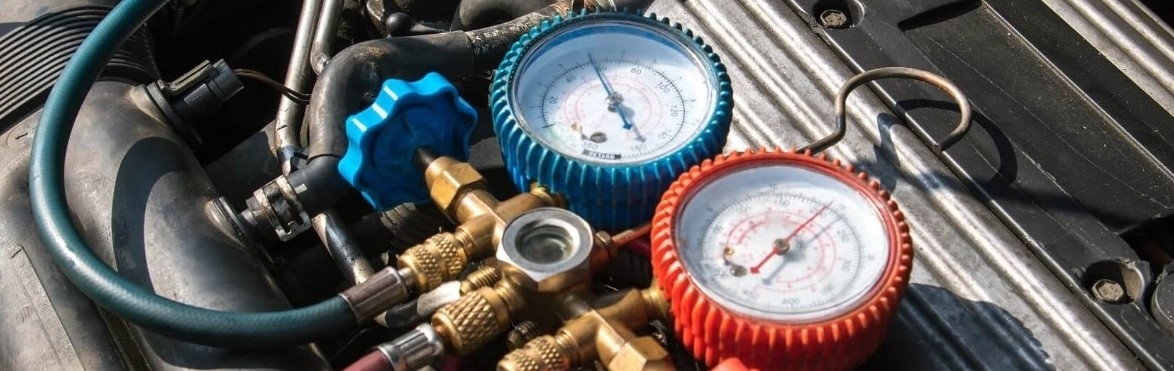
A/C complaints are easy to misdiagnose because several different failures produce the same symptom: weak or absent cold air. That's why every A/C visit starts with pressure gauges on the high and low side of the system before any part gets ordered.
One recent example involved a vehicle brought in for what the owner assumed was a dead compressor, since the air had stopped cooling entirely. Pressure testing showed the system was simply empty due to a leaking line fitting. A quick fitting replacement and recharge solved it for a fraction of what a compressor swap would have cost.
- Every A/C visit starts with a pressure and leak inspection
- Repairs and estimates are explained before any work begins
- Parts are only replaced when testing confirms the failure
- Technicians use manufacturer-specified refrigerant and lubricant types
After a repair, the system is pressure tested again and run through a cooldown check to confirm vent temperatures meet spec before the vehicle is handed back.
This process applies to all makes and models serviced at Friendly Honda of Springfield, and most A/C diagnostics can be completed the same day with a scheduled appointment.
A/C Repair for Honda Owners in Springfield
Honda models from the Civic and Accord to the CR-V and Pilot use refrigerant and system specifications that vary by year and trim, and technicians confirm the correct type by VIN before servicing any vehicle. Getting the refrigerant type and oil wrong can damage a compressor, so this step isn't skipped.
Most leak inspections and recharges can be completed within a couple of hours with a scheduled appointment, though compressor or condenser replacements typically take longer depending on parts availability. The service advisor will give an honest estimate before work begins rather than a vague promise.
- Refrigerant type and system capacity confirmed by VIN
- Manufacturer-approved recovery and recharge equipment used on every vehicle
- Same-day diagnostics available in most cases with an appointment
Find Friendly Honda of Springfield in Springfield, IL
Serving Springfield and the Surrounding Area
Drivers from throughout central Illinois bring their vehicles to Friendly Honda of Springfield for A/C repair, especially once summer humidity makes a weak system impossible to ignore.
- Chatham, IL
- Sherman, IL
- Rochester, IL
- Riverton, IL
- Auburn, IL
- New Berlin, IL
- Pleasant Plains, IL
- Jerome, IL
Wherever the drive starts, the diagnostic process stays the same, and appointments can be scheduled online in minutes.
Questions Drivers Ask Before an A/C Visit
These come up often, no matter what's parked in the driveway.
Q: Why does my A/C blow cold sometimes and warm other times?
Q: Is it normal for A/C systems to need refrigerant added every year?
Q: Why does the cabin smell musty when the A/C turns on?
Q: What does an A/C inspection at your service center include?
Q: Do you work on A/C systems for brands other than Honda?
Noticing weaker airflow or a strange smell from the vents? Call the service desk and describe what's happening so the team can advise on next steps.
A quick conversation now can save a bigger repair later.
Book A/C Service at Friendly Honda of Springfield
A small refrigerant leak left alone doesn't stay small. Left unchecked, low refrigerant can starve the compressor of lubrication and turn an inexpensive fix into a full component replacement.
Every recommendation comes after testing, not before. No repairs are started without walking through the findings and getting approval first.
Appointments can be booked online in a few minutes, by phone, or in person at the service desk. Same-day diagnostic slots are often available.
Service Specials

Brake Savings
Brakes, OEM brake pad installation, comprehensive brake inspection to help keep you stopping safely


